The Greek government allocates 1.17 billion euros to port infrastructure and subsidized island ferry services, with 670 million euros earmarked through 2030....
A new ICSI report presented at COP31 highlights 100 transport climate resilience initiatives across 46 countries, including a mobility project in Trikala, Greece....
COCO-MAT Athens BC launches an exclusive Black Friday offer for direct bookings until December 10, inviting travelers to experience Athens in comfort and style....
Η ΕΝΑΚ θα ενημερώσει τους ξενοδόχους στην έκθεση Xenia 2026 για τις υποχρεώσεις ναυαγοσωστικής κάλυψης, ανάλογα με το βάθος της πισίνας και τον αριθμό δωματίων....
Ναυπήγηση, πολυτελής φιλοξενία, ασφάλιση σκαφών και ανθρώπινος παράγοντας στο πρόγραμμα του 6ου Πανελλήνιου Συνεδρίου Yachting που θα πραγματοποιηθεί στις 25-26 Φεβρουαρίου 2027....
Η ελβετική παραγωγή «Swiss Sounds by Thylacine» απέσπασε το Grand Prix στο 17ο Φεστιβάλ Τουριστικών Ταινιών Αμοργού, ενώ ο ΕΟΤ διακρίθηκε για την καμπάνια «Your Greece, Your Path»....
Some of the most common questions in our Facebook Group are about money. Where to get the best exchange rates, what cards to use, and even what currency to use. A lot of outdated advice still gets shared, which can confuse people and leave them without critical on-the-ground information. We’ve done some comparisons for you so you can make informed decisions about using money in Greece.
What currency does Greece use?
Greece uses the euro (€). Prices, cash payments and ATM withdrawals are in euros.
Do you need cash in Greece?
Yes, carry some euros for small purchases, tips and occasions when card payments are unavailable. Visa and Mastercard are widely accepted, so you don’t need your entire holiday budget in cash.
Can you use US dollars in Greece?
Generally, no. US dollars are not accepted for everyday purchases. Exchange them for euros or withdraw euros from an ATM using your debit card.
How much cash should you bring?
If you plan to pay mainly by card, we suggest starting with €100–€200 per person and withdrawing more as needed. This is a cash buffer, not your total spending budget. Carry small notes and allow more if you’re visiting remote areas or have accommodation or activities to pay for in cash.
What is the best way to get money for Greece?
Withdraw euros from a Greek bank ATM
For most travellers, using a debit card with low overseas withdrawal fees and a competitive exchange rate at a Greek bank ATM is one of the best-value ways to get cash. Check both your card provider’s charges and the ATM’s withdrawal fee before proceeding. Travel cards can also offer good value, but conversion fees and withdrawal limits vary.
Avoid expensive exchange counters and ATMs
Airport exchange counters often offer poor value because an unfavourable exchange rate can outweigh any advertised “no commission” offer. Independent ATMs, including Euronet and Cashzone, can also charge steep withdrawal fees. Compare the total cost, including both the exchange rate and any charges.
Ordering euros from your bank isn’t necessarily free
“Just order euros from your bank before you leave” is still common advice, but it isn’t automatically the cheapest option. Even without a separate fee, banks can build their profit into the exchange rate, giving you fewer euros for your money. Delivery charges may also apply. Some banks no longer handle foreign cash, while others require advance orders or collection from selected branches. Ordering a small amount for arrival can be convenient, but compare costs before buying your entire holiday cash supply.
Decline the ATM’s currency conversion
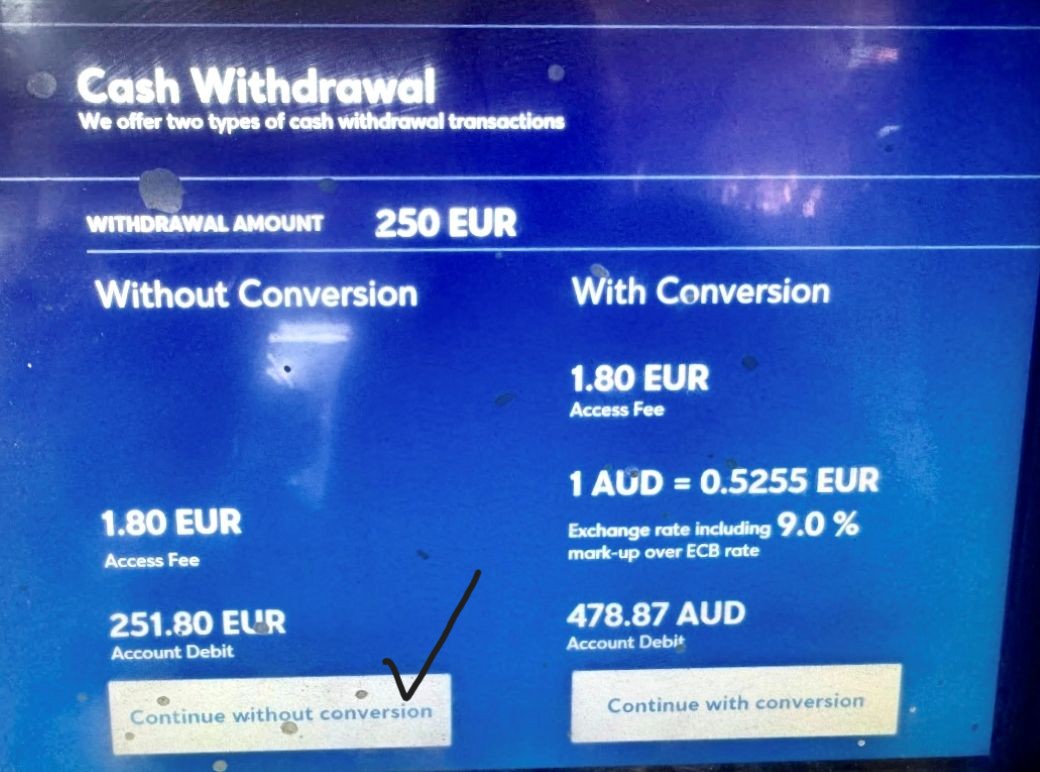
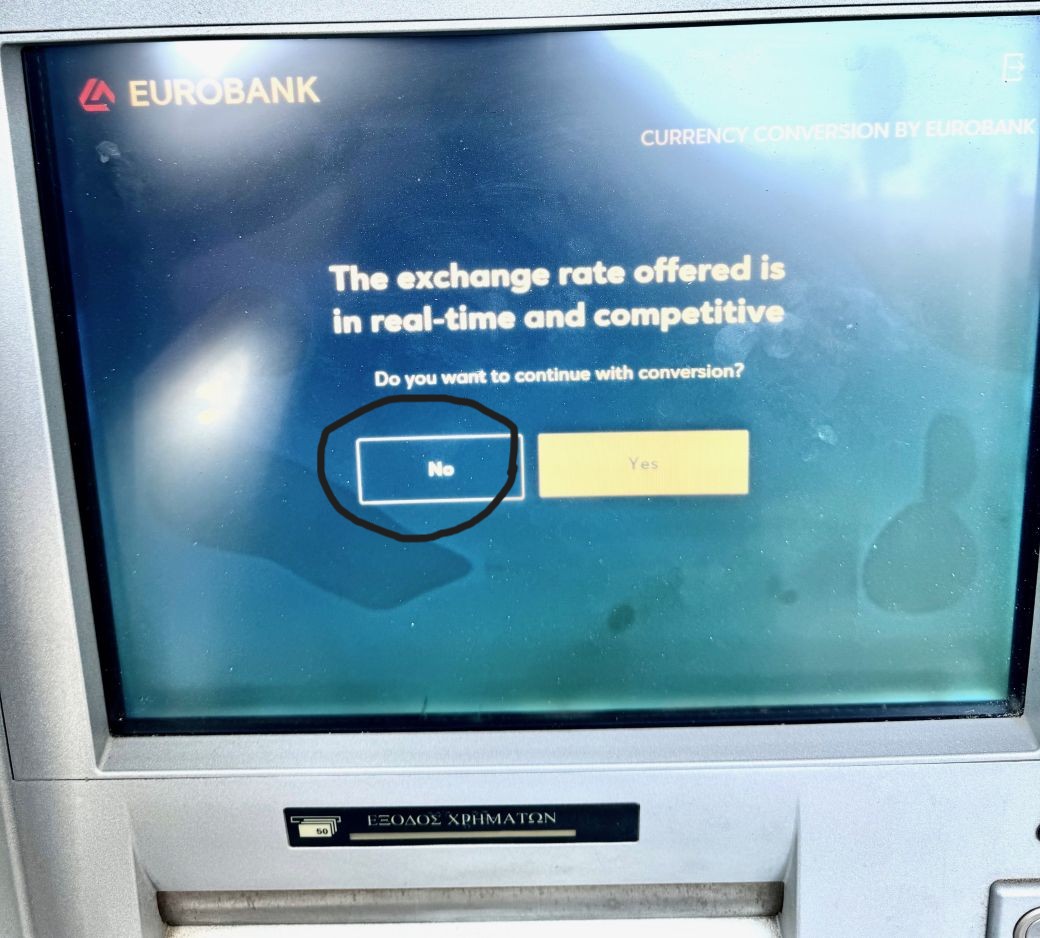
This is the critical step, and where many travellers go wrong. If an ATM offers to convert your withdrawal into your home currency, choose euros and select “Decline conversion” or “Continue without conversion”. You are declining the ATM’s exchange rate, not cancelling the withdrawal. Your card provider then handles the conversion instead, although any separate withdrawal fee still applies.
The photos below show examples from my own ATM withdrawals, so you can recognise what to look for on screen.
Foreign Currency exchange rates and fees ( November, 2026)
US Dollars: US$100 to Euros
Method
Fees and exchange rate
Euros you get
Benchmark, before fees
US$1 ≈ €0.8916.
€89.16
Wise
Mid-market rate minus the quoted conversion fee. Funding and ATM charges may also apply.
€88.27 if the conversion fee is US$1. Example only, before ATM charges.
Revolut
Revolut’s quoted rate. Fees depend on your plan, allowance and when you exchange.
Compare the live quote with the €89.16 benchmark. ATM charges are separate.
US banks or AAA/CXI, cash before travel
Retail cash rate, plus any service or delivery charges.
€84.70 if the total cost is 5% of your budget. Example only.
Greek bank ATMs
Allow €1–€2 per withdrawal for this comparison. Check the displayed charge. Your own bank may charge separately.
€87.16–€88.16 after the assumed ATM fee, before your own bank’s charges.
Independent ATMs: Euronet, Cashzone and others
Allow €5–€10 per withdrawal for this comparison. Your own bank may charge separately. Accepting the ATM’s conversion adds an exchange-rate cost.
€79.16–€84.16 after the assumed ATM fee, before your own bank’s charges, with conversion declined.
Updated 3 November 2026 using the ECB reference rate dated 2 November 2026. US$100 is the total budget, including stated fees. Calculations are illustrations, not provider quotes. ATM fees vary by machine and card; the €1–€2 and €5–€10 ranges are comparison assumptions. ATM examples use the benchmark exchange rate. Cash denominations may prevent withdrawing these exact amounts.
ATM tip: Choose euros and decline any offered conversion into US dollars. This avoids the ATM’s conversion rate, but does not remove its withdrawal fee.
Australian Dollars: A$100 to Euros
Method
Fees and exchange rate
Euros you get
Benchmark, before fees
A$1 ≈ €0.6248.
€62.48
Wise
Mid-market rate minus the quoted conversion fee. Funding and ATM charges may also apply.
€61.86 if the conversion fee is A$1. Example only, before ATM charges.
Revolut
Revolut’s quoted rate. Fees depend on your Australian plan, allowance and when you exchange.
Compare the live quote with the €62.48 benchmark. ATM charges are separate.
Australian banks or currency bureaux, cash before travel
Retail cash rate, plus any service or delivery charges.
€59.36 if the total cost is 5% of your budget. Example only.
Greek bank ATMs
Allow €1–€2 per withdrawal for this comparison. Check the displayed charge. Your own bank may charge separately.
€60.48–€61.48 after the assumed ATM fee, before your own bank’s charges.
Independent ATMs: Euronet, Cashzone and others
Allow €5–€10 per withdrawal for this comparison. Your own bank may charge separately. Accepting the ATM’s conversion adds an exchange-rate cost.
€52.48–€57.48 after the assumed ATM fee, before your own bank’s charges, with conversion declined.
Updated 3 November 2026 using the ECB reference rate dated 2 November 2026. A$100 is the total budget, including stated fees. Calculations are illustrations, not provider quotes. ATM fees vary by machine and card; the €1–€2 and €5–€10 ranges are comparison assumptions. ATM examples use the benchmark exchange rate. Cash denominations may prevent withdrawing these exact amounts.
ATM tip: Choose euros and decline any offered conversion into Australian dollars. This avoids the ATM’s conversion rate, but does not remove its withdrawal fee.
Canadian Dollars: C$100 to Euros
Method
Fees and exchange rate
Euros you get
Benchmark, before fees
C$1 ≈ €0.6380.
€63.80
Wise
Mid-market rate minus the quoted conversion fee. Funding and ATM charges may also apply.
€63.17 if the conversion fee is C$1. Example only, before ATM charges.
Canadian banks or currency bureaux, cash before travel
Retail cash rate, plus any service or delivery charges.
€60.61 if the total cost is 5% of your budget. Example only.
Greek bank ATMs
Allow €1–€2 per withdrawal for this comparison. Check the displayed charge. Your own bank may charge separately.
€61.80–€62.80 after the assumed ATM fee, before your own bank’s charges.
Independent ATMs: Euronet, Cashzone and others
Allow €5–€10 per withdrawal for this comparison. Your own bank may charge separately. Accepting the ATM’s conversion adds an exchange-rate cost.
€53.80–€58.80 after the assumed ATM fee, before your own bank’s charges, with conversion declined.
Updated 3 November 2026 using the ECB reference rate dated 2 November 2026. C$100 is the total budget, including stated fees. Calculations are illustrations, not provider quotes. ATM fees vary by machine and card; the €1–€2 and €5–€10 ranges are comparison assumptions. ATM examples use the benchmark exchange rate. Cash denominations may prevent withdrawing these exact amounts.
ATM tip: Choose euros and decline any offered conversion into Canadian dollars. This avoids the ATM’s conversion rate, but does not remove its withdrawal fee.
British Pounds: £100 to Euros
Method
Fees and exchange rate
Euros you get
Benchmark, before fees
£1 ≈ €1.1965.
€119.65
Wise
Mid-market rate minus the quoted conversion fee. Funding and ATM charges may also apply.
€118.45 if the conversion fee is £1. Example only, before ATM charges.
Revolut
Revolut’s quoted rate. Fees depend on your UK plan, allowance and when you exchange.
Compare the live quote with the €119.65 benchmark. ATM charges are separate.
UK banks or currency bureaux, cash before travel
Retail cash rate, plus any service or delivery charges.
€113.66 if the total cost is 5% of your budget. Example only.
Greek bank ATMs
Allow €1–€2 per withdrawal for this comparison. Check the displayed charge. Your own bank may charge separately.
€117.65–€118.65 after the assumed ATM fee, before your own bank’s charges.
Independent ATMs: Euronet, Cashzone and others
Allow €5–€10 per withdrawal for this comparison. Your own bank may charge separately. Accepting the ATM’s conversion adds an exchange-rate cost.
€109.65–€114.65 after the assumed ATM fee, before your own bank’s charges, with conversion declined.
Updated 3 November 2026 using the ECB reference rate dated 2 November 2026. £100 is the total budget, including stated fees. Calculations are illustrations, not provider quotes. ATM fees vary by machine and card; the €1–€2 and €5–€10 ranges are comparison assumptions. ATM examples use the benchmark exchange rate. Cash denominations may prevent withdrawing these exact amounts.
ATM tip: Choose euros and decline any offered conversion into pounds. This avoids the ATM’s conversion rate, but does not remove its withdrawal fee.
USA: Foreign Transaction Fees & Travel Cards
Bank/Card
Foreign Transaction Fee
Annual Fee (USD)
Notes
Chase Sapphire Preferred
None
US$95
Travel rewards and travel protection benefits, subject to conditions.
Chase Sapphire Reserve
None
US$795
Premium travel rewards, lounge access and travel credits. Check eligibility and conditions for each benefit.
Bank of America Travel Rewards
None
US$0
Earns points redeemable towards eligible travel and dining purchases.
Capital One VentureOne
None
US$0
Earns 1.25 miles per dollar on everyday purchases, with additional rewards on eligible Capital One Travel bookings.
Capital One Savor Rewards
None
US$0
Cash back on dining, groceries and entertainment. This is the Savor Rewards card; the current SavorOne product has different pricing.
U.S. Bank Altitude Connect
None
US$0
Travel rewards and selected travel benefits, subject to limits and conditions.
Other US debit and credit cards
Varies by card
Varies
Check the card’s fee schedule. Overseas ATM fees and cash advance charges are separate from foreign transaction fees.
Updated November 2026. Fees shown apply to the listed US card products and may change. Additional cardholder fees may apply. No foreign transaction fee does not mean free ATM withdrawals: credit card cash withdrawals can incur cash advance fees and interest.
When paying in Greece: Choose euros if the terminal offers a choice between euros and US dollars, so your card provider handles the conversion.
Australia: FX Fees & Travel Cards
Bank/Card
Foreign Transaction / Conversion Fee
Annual or Ongoing Fee (AUD)
Notes
Wise debit card
Mid-market exchange rate plus a variable conversion fee.
No annual fee. A$10 one-off physical card fee.
No conversion needed when spending an existing balance in the matching currency. ATM fees apply above allowances; local ATM charges may also apply.
Revolut Standard debit card
No additional weekday exchange fee within the A$2,000 monthly allowance. A 0.5% fee applies above the allowance; a 1% fee applies outside exchange market hours.
No subscription fee. Card delivery charges may apply.
Uses Revolut’s quoted exchange rate. ATM withdrawal limits and fees are separate. Paid plans have different allowances.
Westpac Lite credit card
None
A$9 monthly, equivalent to A$108 a year.
Cash advances are not available. Westpac has announced changes effective 30 November 2026, so check the latest pricing before applying.
Bankwest Zero Platinum Mastercard
None
A$0
No Bankwest overseas ATM fee, but credit card cash advance fees and interest may apply. Local ATM operators may charge separately.
Latitude 28° Global Platinum Mastercard
No international transaction or currency conversion fee on purchases.
Standard annual fee: A$96. Fee waivers are available, subject to conditions.
Advertised waivers include the first year for eligible new customers and subsequent years with A$12,000 in eligible annual spending. Cash advance charges apply to withdrawals.
NAB Platinum Visa Debit
No international transaction fee on purchases.
A$10 monthly, equivalent to A$120 a year.
The purchase fee exemption does not extend to overseas ATM withdrawals. International transaction and overseas ATM withdrawal fees apply to cash withdrawals.
Other Australian debit and credit cards
Varies by card, commonly around 3%–3.5%.
Varies
Check the specific card’s fee schedule. International transaction fees can also apply to purchases charged in Australian dollars but processed overseas.
Updated 3 November 2026. Fees apply to the Australian products listed and may change. Promotional waivers, exchange allowances and benefits are subject to conditions. No foreign transaction fee does not mean free ATM withdrawals.
When paying or withdrawing cash in Greece: Choose euros if offered a choice of currencies, so your card provider handles the conversion. Check any separate ATM withdrawal fee before confirming.
There’s never a bad time to visit Europe, but when is the best time to visit Greece? Is it best to visit Greece in June or September, or some other time?
June and September are very popular these days, with people trying to capture the summer vibes but avoid the peak period prices and crowds that can occur in July and August. Both have their pros and cons, and we’ve summarised them in this table. Hope it helps!
June14.5 to 15 hours. Long evenings with sunset close to 9.00pm, giving you plenty of time for sightseeing and outdoor dining.
September12.5 to 13 hours. Still generous daylight, but the evenings are noticeably shorter.
Visitor numbers
June
Busy, but with a sense that the season is just getting underway. Attractions, beaches and tavernas are lively without quite the same intensity as later in summer.
September
Despite its reputation as shoulder season, September is now one of Greece’s busiest months. Expect full ferries, busy islands and crowded attractions, especially during the first three weeks.
Air temperatures
June
Typically 26 to 31°C, with warm, sunny days and comfortable evenings.
September
Typically 25 to 30°C. Mornings and evenings can be slightly cooler, while daytime temperatures remain ideal for swimming and sightseeing.
Sea temperatures
June
Around 22 to 24°C. Refreshing, but generally comfortable for swimming.
September
Around 25 to 27°C. Usually among the warmest sea temperatures of the year.
Weather reliability
June
One of the most settled months of the year, with long periods of sunshine and very little chance of rain.
September
Generally warm and sunny, but less predictable than June. Rain, thunderstorms and occasional storms become more likely later in the month, particularly on the mainland and in northern Greece.
Wind
June
The Meltemi can occur during June, particularly in the Cyclades, although prolonged windy periods are generally less common than later in summer.
September
Do not assume September will be calm. The Meltemi can continue strongly for days at a time, affecting ferries, boat trips and beach conditions, especially in the Cyclades.
Season atmosphere
June
Hotels, tavernas and tourism staff are fresh and enthusiastic at the beginning of the main summer season. Everything feels energised and ready for summer.
September
By September, many tourism workers have been working seven days a week for several months. Service may still be excellent, but popular destinations can have a noticeably tired, end-of-season feel.
Shops and supplies
June
Shops are generally fully stocked with new-season clothing, local products, souvenirs and summer essentials.
September
Most businesses remain well stocked, although shops on smaller islands may begin running down seasonal inventory later in the month ahead of winter closures.
Landscape
June
Greece is greener after spring. Wildflowers may still linger, hillsides are less dry and the countryside feels fresher.
September
After months of heat, much of the landscape is dry and golden. Vineyards and orchards are busy harvesting.
Seasonal food
June
Cherries, apricots, peaches, nectarines, strawberries, melons, tomatoes, cucumbers, courgettes, green beans and fresh herbs.
September
Grapes, figs, pomegranates, pears, apples, plums, walnuts and wine grapes. The olive harvest may also begin in some regions in late September.
Prices
June
High-season pricing generally kicks in towards the end of the month, although prices may still be lower than in July and August.
September
Often still high season across most popular destinations. Significant reductions generally do not appear until late in the month or in October.
Best for
June
Long sightseeing days, greener landscapes, hiking, photography and enjoying the fresh energy of early summer.
September
Warm sea swimming, harvest season and travellers who do not mind crowds in exchange for excellent swimming conditions.
Our take
After spending many Septembers in Greece, we went back to June this year, and it was pretty much perfect. There was a week of wind in the Cyclades, but the days were longer, it was greener, businesses felt fresh and well stocked, and the overall atmosphere was very relaxed.
September can still offer warm seas (this is very subjective though), but we have found that it has become every bit as busy as June in recent years, if not more so. There is a good chance of prolonged Meltemi winds and a noticeably more tired, end-of-season atmosphere in many popular destinations. Don't get me wrong, this is still a solid choice and our 2nd favourite time of the year.
May is also a great time to visit, especially for sightseeing. The sea can be cold for some, but if you love exploring and plan to do a lot of walking and/or hiking, May temps are mild, and the spring flowers and foliage can be beautiful.
The Hellenic Hoteliers Federation has formed its new Board, with responsibilities spanning strategic development, digital transformation, environmental issues and special-interest tourism....
Athens public transport operators outline plans for more drivers, major rail investment and new hydrogen buses as passenger demand continues to grow....
Mount Olympus National Park is set for a major expansion under a new environmental plan that places 58% of the enlarged area under strict protection....
Stone craft, food traditions, dances, processions and local customs are among ten new additions to Greece’s National Index of Intangible Cultural Heritage....
Celestyal is expanding its Mediterranean deployment in 2027 with new Greek destinations, while calling for predictable cruise policy and port investment....
 Login